

9 AM to 7 PM Monday-Saturday
+91-9251896142 (Sales)
+91-9251896141 (Sales)
+91-9251896140 (Sales)

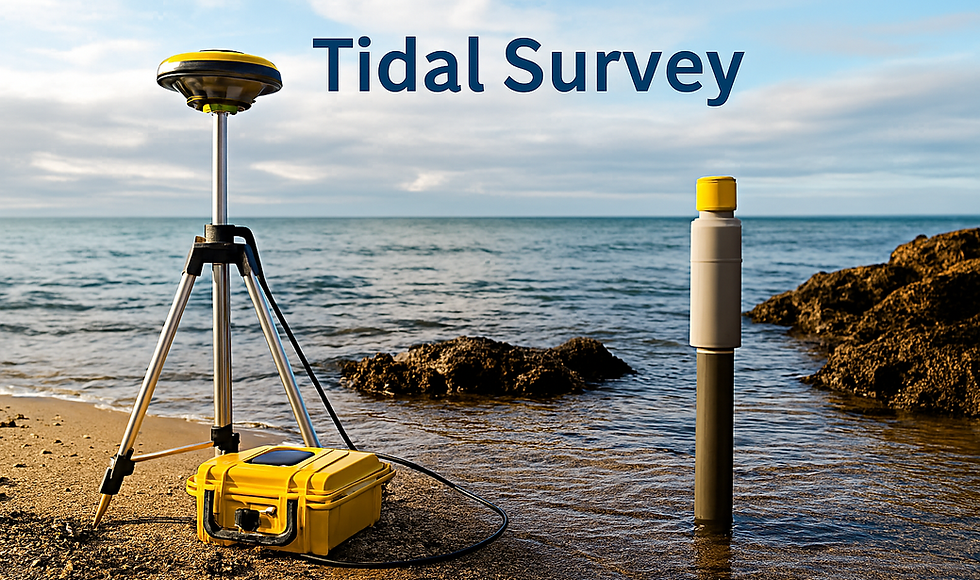
Tidal Survey company in Dhule, Maharashtra.To analyzing tidal movements the rise and fall of sea levels
A tidal survey is a specialized type of hydrographic survey that focuses on measuring and analyzing tidal movements—essentially, the rise and fall of sea levels caused by gravitational forces from the moon and sun. Here's a breakdown tailored to your interests in hydrogeology, geophysical methods, and field documentation. What Is a Tidal Survey? A tidal survey involves collecting data on water levels over time to establish tidal datums—reference points used for mapping, coastal engineering, and navigation. These datums help define boundaries like mean sea level (MSL), mean high water (MHW), and mean low water (MLW).
Key Applications
• Coastal Mapping & Engineering: Establishing accurate shoreline positions and elevations for construction, erosion control, and flood modeling.
• Hydrographic Charting: Supporting safe navigation by defining chart datums (usually the lowest astronomical tide).
• Environmental Monitoring: Tracking sea-level changes, storm surge impacts, and climate-related shifts.
• Legal & Regulatory Boundaries: Defining tidelands and maritime boundaries for property and jurisdictional purposes.
Survey Workflow Overview
1. Site Selection: Choose locations for tide gauges or pressure sensors.
2. Instrument Deployment: Install tide gauges, GPS receivers, and sometimes radar or acoustic sensors.
3. Data Collection: Record water levels over a lunar cycle (typically 29 days or more).
4. Datum Calculation: Analyze data to determine tidal datums like MSL, MHW, MLW, and Chart Datum.
5. Integration: Use datums to adjust bathymetric maps, coastal models, and engineering designs
Standard field workflow
1. Site selection and geodetic control (establish bench marks tied to national datum).
2. Install and level tide gauge(s); install redundant sensors where possible.
3. Continuous water-level recording over an adequate period (commonly a full lunar cycle or longer for formal datums).
4. Quality control, datum computation (statistical averaging to derive MSL, MHW, MLW, etc.), and conversion to project vertical datum.
5. Apply tidal corrections to bathymetry and produce final maps, reports, and metadata
Tidal Survey company in Dhule, Maharashtra.To analyzing tidal movements the rise and fall of sea levels
Application: Tidal Survey company in Dhule, Maharashtra.hydrographic survey that focuses on measuring and analyzing tidal movements—essentially, the rise and fall of sea levels
Applications of Tidal Survey
A tidal survey provides time-series water-level measurements and computed tidal datums used to reference elevations, correct bathymetry, and characterise temporal sea-level behaviour for engineering, navigation, environmental and hazard applications.
Coastal engineering and infrastructure planning
• Uses: design of seawalls, breakwaters, beach nourishment, harbour entrances, coastal roads and bridges; setting foundation elevations and freeboard.
• Why it matters: accurate, location-specific tidal datums and short-term water-level behaviour reduce vertical uncertainty in designs and prevent costly mismatches between structure and actual tidal extremes. Hydrographic charting and safe navigation
• Uses: conversion of echo-sounder depths to chart datum; creation of charted clearance and berth depths; local cotidal corrections for multi-beam surveys and real‑time onboard corrections.
• Why it matters: tidal corrections are a primary source of vertical uncertainty in hydrographic surveys; using tide models or local gauge ties improves real‑time correction and survey accuracy.
Hazard monitoring, tsunami and storm‑surge systems
• Uses: real‑time tide monitoring for early warning systems, storm‑surge forecasting, and post‑event inundation mapping.
• Operational example: national tide‑gauge networks co‑located with GNSS and real‑time telemetry are used to feed tsunami and storm‑surge centres for rapid analysis and alerting coastal communities.
Environmental monitoring, sea‑level change and habitat mapping
• Uses: long‑term sea‑level trend analysis, salt‑water intrusion studies, intertidal habitat (mudflat, mangrove) mapping, and ecological change monitoring.
• Techniques: integration with airborne LiDAR, topographic surveys, and synchronized GNSS-RTK to build DEMs of tidal flats and quantify elevation changes; LiDAR + tide ties can produce high‑resolution DEMs suitable for habitat assessment and erosion studies. Integration with geophysical, hydrogeological and surveying methods
• Best practices: co‑locate tide gauges with nearshore geophysical lines to minimise temporal/positional correction errors; use pressure sensors with barometric compensation and GNSS vertical control to transfer datums; apply local-area tide models where tidal amplitude and phase vary rapidly.
• Result: more consistent bathymetric products, better alignment between onshore benchmarks and offshore depths, and improved confidence when combining datasets from different campaigns.
